Johannesburg Tourism - www.joburgtourism.com
Soweto
Early development
The establishment of Soweto is, like Johannesburg, linked directly to the discovery of Gold in 1885. Thousands of people from around the world and South Africa flocked to the new town to seek their fortunes or to offer their labour. Within 4 years Johannesburg was the second largest city. More than half the population was black, most living in multi racial shanty towns near the gold mines in the centre of the town. As the gold mining industry developed, so did the need for labour increase. Migrant labour was started and most of these workers lived in mine compounds. However other workers had to find their own accommodation often in appalling conditions.
The first residents of what is now known as Soweto were located into the area called Klipspriut in 1905 following their relocation from “Coolietown” in the centre of Johannesburg as a result of an outbreak of bubonic plague. The Johannesburg City Council took the opportunity to establish racially segregated residential areas. Some residents were to be relocated to Alexandra township (near the present day Sandton). This group comprised black, Indian and coloured families and they received freehold title to their land (this was subsequently reversed by the Apartheid Government). Only black families were located into Klipspruit and the housing was on a rental basis. Klipspruit was subsequently renamed Pimville.
During the 1930’s the demand for housing for the large numbers of black people who had moved into Johannesburg grew to such an extent that new housing was built in an area known as Orlando, named after the first administrator Edwin Orlando Leaky.
In the 1940’s a controversial character James Mpanza led the first land invasion and some 20000 squatters occupied land near Orlando. James Mpanza is known as the “Father of Soweto”.
In 1959 the residents of Sophiatown were forcibly removed to Soweto and occupied the area known as Meadowlands. Sir Earnest Oppenheimer, the first chairman of the Anglo American Corporation, was appalled by the housing shortage and was instrumental in arranging a loan for the construction of additional housing and this is commemorated by the Oppenheimer Tower in Jabulani.
Current status of Soweto.
Soweto falls within the municipality of the Johannesburg Metro Council in the province of Gauteng which appropriately means place of Gold.
The original rental houses have now been sold to the tenants who received a subsidy from the government to cover the cost of the houses. Private sector housing was developed from the 1980’s funded by the various banks. Freehold title is available to the properties.
Services are provided by the Johannesburg Metro council and electricity by Escom.
Origins of the name.
Soweto obtained its name from the first two letters of South Western Township which was the original description of the area.
“Soweto is a symbol of the New South Africa, caught between old squatter misery and new prosperity,
squalor and an upbeat lifestyle, it’s a vibrant city which still openly bears the scars of the Apartheid past
and yet shows what’s possible in the New South Africa”
Overview
SOWETO is the most populous black urban residential area in the country, with a population of around a million. Thanks to its proximity to Johannesburg, the economic hub of the country, it is also the most metropolitan township in the country - setting trends in politics, fashion, music, dance and language.
History
Soweto's origins go back to 1903, when Kliptown was established after authorities cleared an inner city slum on the pretext of trying to eradicate an outbreak of bubonic plague.
June 16, 1976
Soweto exploded in violent riots on June 16, 1976, when schoolchildren took the struggle against apartheid into their own hands. Hundreds of children around the country died on this day, but South Africa was never to be the same again – the slow road to democracy had begun, culminating in the elections of 1994 and the established of democracy in the country.
Tour guides
A tour of Soweto is a must for every visitor to Johannesburg.
Restaurants
Johannesburg has some great places to eat at, serving authentic African dishes. Some are in Soweto.
Accommodation
Enjoy Soweto's special brand of hospitality. Stay over in a B&B in the township.
Museums
In the last few years Soweto has had its heritage recognised in the form of several museums. The Hector Pieterson Museum recognises the young 12-year-old's sacrifice and hundreds of other children who gave their lives for freedom. The Kliptown Open-Air Museum acknowledges the people who contributed to the drafting of the Freedom Charter. Mandela House is the restored house where Nelson Mandela lived with Winnie Madikizela-Mandela and his first wife, Evelyn. And on the outskirts of Soweto is the Apartheid Museum, a museum that traces the horror of apartheid.
Soccer City:
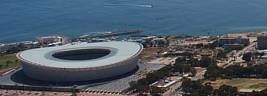
FNB Stadium, known as Soccer City during the 2010 FIFA World Cup, is a stadium located in Nasrec, the Soweto area of Johannesburg, South Africa. It is located next to the South African Football Association headquarters (SAFA House) where both the FIFA offices and the Local Organising Committee for the 2010 FIFA World Cup were housed.Designed as the main association football stadium for the World Cup, the FNB Stadium became the largest stadium in Africa with a capacity of 94,700, However its maximum capacity during the 2010 FIFA World Cup was 84,490 due to reserved seating for the press and other VIP's. The stadium is also known by its nickname "The Calabash" due to its resemblance to the African pot or gourd.
It was the site of Nelson Mandela's first speech in Johannesburg after his release from prison. It was also the site of Chris Hani's funeral.
Sandton
Sandton is a wealthy area situated within the metro of Johannesburg, Gauteng, South Africa. The name comes from the combination of two of its suburbs, Sandown and Bryanston, both of which were named after places in the United Kingdom[citation needed]. In 1969 Sandton was promulgated as a municipality in its own right,but lost its status as an independent town after the re-organisation of South African local governments.
One of the main attractions in Sandton is Sandton City, which ranks among the largest shopping centres in Africa. Together with Nelson Mandela Square, the centre, with some 144,000 m2 of shopping space, is one of the largest in the Southern Hemisphere, larger than Sydney's Westfield Parramatta or Melbourne's Southland Shopping Centres. Much of Johannesburg's business tourism is centred on Sandton, which has a string of 5-star hotels.
It was recently announced by Liberty Properties that Sandton City will receive a R1,77-billion upgrade. Liberty Properties chief executive Samuel Ogbu has envisaged the complex as South Africa's very own Wall Street "Africa is not for sissies, but we have a bold vision, which is to see the Sandton City precinct as our own Wall Street." The redevelopment will include the construction of a 60-storey office tower, a new hotel, new retail and office space and residential apartments. The 60-storey office tower will be the tallest building in Africa, replacing the Carlton Centre in Johannesburg CBD. The extension will stretch to 30 000 m2 and the total complex will have a gross lettable area of 158 000 m2 . London-based RTKL Associates have been chosen to design the complex.
Nelson Mandela Square, formerly known as Sandton Square, was renamed in March 2004, after the unveiling of a 6-metre bronze statue of the former president, one of South Africa's greatest statesmen. Perhaps ironically, Liliesleaf Farm, where Nelson Mandela lived in the early 1960s and where many leading political activists were arrested in 1963 and tried as part of the now infamous Rivonia Trial, is just north of Nelson Mandela Square, close to the N3 Highway, off Rivonia Road.
Gautrain is an 80-kilometre mass rapid transit railway system in Gauteng Province, South Africa, which links Johannesburg, Pretoria, and OR Tambo International Airport. It is hoped that this railway will relieve the traffic congestion in the Johannesburg–Pretoria traffic corridor and offer commuters a viable alternative to road transport, as Johannesburg has limited public transport infrastructure. As of 18 June 2010, the OR Tambo International Airport, Rhodesfield, Marlboro, and Sandton stations have been completed.

 CellC Tour of South Africa on Facebook